Support
General Product Questions
What kind of warranty and product support come with NVIS products?
Our standard product warranty is one year, and service contracts are available to extend the warranty to 3 years. Contact NVIS or a reseller in your area. Technical support is always available. Simply contact us by phone or email.
Why are NVIS products so expensive?
NVIS products are built from state-of-the-art, high-performance optics and electronics designed to provide outstanding visual acuity for the most demanding, professional VR applications in the world. The market for such products is small but growing. NVIS products are manufactured in volumes that are orders of magnitude smaller than those of consumer electronic products, and this results in higher prices.
What are some of the more important performance parameters to consider when purchasing a VR display?
Depending on the application, the most common capability parameters include resolution and color depth, field-of-view, and brightness and/or contrast. Some lesser known but equally important specifications include the exit pupil and eye relief. A large exit pupil provides a large “sweet-spot”, making it easier for the user to move their eyes and head without losing the image, and a large eye relief accommodates eyeglasses without clipping or vignetting the virtual image.
How can I see a demonstration of NVIS products?
Call us. We schedule demonstrations in Europe, Asia, and the US throughout the year. The major shows and events we attend include 1) ITEC, 2) IEEE VR, 3) IVR, and our largest event 4) I/ITSEC.
How can I buy NVIS products?
NVIS products can be purchased through our active worldwide reseller network or direct from NVIS.
What are the general system requirements to use NVIS products?
NVIS recommends modern graphics workstations using industry standard video cards from nVidia or ATI. We do not test our products on each and every platform, but we've found relatively few issues related to compatibility with standard hardware. Product documentation that ships with your order contains technical details on the video format requirements for each NVIS product.
How is motion tracking integrated? What products are supported?
NVIS products accommodate most standard motion trackers via mounting points either on or inside the display devices. The nVisor SX, for example, has a flat mounting point on the back of the HMD for inertial and magnetic trackers, and also accommodates the InterSense IS-900 6 DOF tracker internally.
How long are the cables from the display to the control unit?
The cable length from the HMD or HHD to the VCU is approx 15 feet in most NVIS units.
What comes with an NVIS Virtual Reality Display?
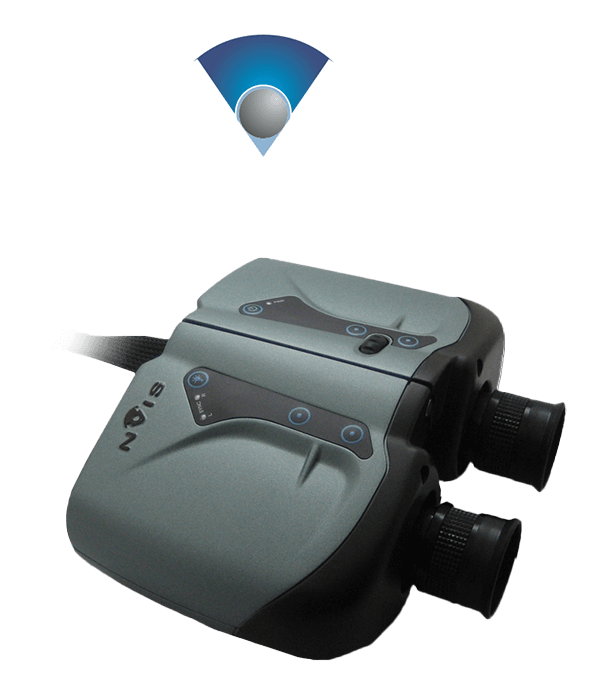
All NVIS VR displays come with a display unit, a video control unit, and necessary accessories including power cord, video cable, adapters, and a user manual. The display unit is usually referred to a head-mounted display or a hand-held display, named the HMD and HHD, respectively. The video control unit is called the VCU for short.
How do these products work?
Most virtual reality displays work on similar principles. They magnify and refocus images from one or more small displays to immerse the user into a virtual environment. Coupled with head tracking, NVIS products allow users to visually interact with these virtual environments. See the technology section of our website for more detailed information.
How do I get started using Virtual Reality?
Head-mounted displays are often thought of as the main technology behind virtual reality. In fact, it's just one of many critical components. Most virtual reality software developers start by building models and environments to construct their virtual worlds. They may use common modelling tools such as 3D Studio Max and Maya. Then many turn to virtual reality authoring software such as Vizard to add real time interaction and support for other virtual reality devices such as motion trackers and, of course, head-mounted displays.
How does a see-through HMD work?
See-through head-mounted displays are used in a subset of Virtual Reality applications called Augmented Reality, or AR. AR allows users to see virtual images superimposed or blended with their physical environment. There are two main categories of see-through head-mounted displays used for AR: Optical see-through and Video see-through. Most AR applications today use optical see-through displays. These displays use mirrors and/or beam-splitters to present a virtual image while the user looks through the eyepieces. The nVisor ST is one example of an optical see-through HMD. Video see-through HMDs are technically not see-through devices. They capture video of the user's surroundings which is then processed through a computer to mix the virtual images. The composited image is then viewed through standard non-see-through eyepieces. The optional VideoVision module provides video see-through capability for the nVisor SX. Both approaches have merit and the decision which to use depends very much on the physical and virtual environments used in the application.